Quotation, BOQ, estimate or invoice?
The words get mixed up, and clients notice when they do. In interior work:
| Document | What it is | When you send it |
|---|---|---|
| Estimate | A rough budget range, with no fixed quantities | After the first meeting, before any design |
| BOQ (bill of quantities) | Every item with its unit, quantity and rate | Once the layout and materials are clear |
| Quotation | The full offer: the BOQ plus GST, payment stages, terms and validity | When you are ready for the client to sign |
| Tax invoice | The bill for one stage, with its own number and the GST charged | At each payment stage in the quotation |
In most interior projects the BOQ sits inside the quotation, so the client signs one document that says what will be done, at what price, and when each payment is due.
What every interior design quotation needs
- Your studio’s details: name, address, phone, email and GSTIN if you are registered.
- Quote number, date and validity: a number you can refer back to, like Q/2026/014, and how long the prices hold.
- Client and site: the client’s name, the site address and the place of supply, which decides how GST is charged.
- Scope in one line: for example, “Turnkey interiors for a 3 BHK apartment, excluding civil work”.
- The BOQ: grouped into sections by room or trade, each line with material, finish, unit, quantity and rate.
- Totals and GST: the total before GST, the GST split, and the grand total.
- Payment schedule: each stage, what triggers it, and its share of the total.
- Terms and exclusions: what is not included, how changes are handled, and the timeline.
- Signatures: space for the client, and for each client if there is more than one owner.
A sample BOQ layout with GST
Here is how the BOQ part of a quotation can be laid out. The rates are placeholders to show the format, not market rates: use your own.
| # | Item | Qty | Rate (₹) | Amount (₹) |
|---|---|---|---|---|
| Modular kitchen | ||||
| 1 | Base units: BWP plywood carcass, laminate shutters, soft-close hinges | 12 rft | 4,000 | 48,000 |
| 2 | Wall units: same carcass and finish as the base units | 10 rft | 3,000 | 30,000 |
| 3 | Quartz counter, 20 mm, with a 4 inch backsplash | 12 rft | 2,500 | 30,000 |
| Bedroom wardrobes | ||||
| 4 | Sliding wardrobe: BWP plywood carcass, laminate finish inside and out | 60 sq ft | 1,800 | 1,08,000 |
| Ceiling and painting | ||||
| 5 | Gypsum false ceiling with a cove for strip lights | 300 sq ft | 150 | 45,000 |
| 6 | Wall painting: putty, primer and two coats of emulsion | 1,200 sq ft | 30 | 36,000 |
| Total before GST | 2,97,000 | |||
| CGST at 9% | 26,730 | |||
| SGST at 9% | 26,730 | |||
| Grand total | 3,50,460 | |||
A few things make a BOQ easier to trust:
- Name the material and finish on every line. “Plywood” invites a dispute; “BWP plywood carcass, laminate shutters” doesn’t.
- Use the unit the trade uses: running feet for kitchens, square feet for wardrobes, ceilings and walls, numbers for fittings.
- Group by room or trade, so a client can see what the kitchen costs without adding up lines.
- Avoid one lump sum. If a line must be a lot, say exactly what the lot includes.
How GST works on an interior quotation
A quotation doesn’t collect tax itself, but it should show the GST your client will pay, so the total they sign is the total they are billed.
- The rate: interior works are usually charged at 18%. If you supply goods on their own, check their rates with your CA.
- Client in your state: charge CGST and SGST, half the rate each, as in the sample above.
- Client in another state: charge IGST at the full rate instead.
- Business clients: add the client’s GSTIN when they are a GST-registered business, such as an office fit-out.
- Not registered for GST? Send the quotation without GST, and don’t show a GST line.
Say clearly whether rates include GST. “All rates exclusive of GST” at the top of the BOQ saves an awkward conversation at the first invoice.
Payment stages and terms
Tie each payment to something the client can see happen, not to a date. Here is an example schedule for a turnkey project. It is one way to split it, not a standard:
- Booking advance, on signing the quotation: 10%
- On design sign-off, before materials are ordered: 30%
- On delivery of materials to site: 30%
- On installation of carpentry and ceilings: 20%
- On handover, after the final walk-through: 10%
Then write down the terms you would otherwise explain on the phone:
- Validity: how long the prices hold, for example 15 or 30 days.
- Exclusions: civil work, electrical and plumbing, appliances, loose furniture, or whatever you don’t include.
- Brands and specifications: what was quoted, and that a change of material changes the rate.
- Changes: additions after signing go in a separate variation order, priced before the work starts.
- Timeline: the working days from design sign-off, and what pauses the clock, such as a site that isn’t ready.
- How to pay: bank transfer or UPI to your studio’s account, with your bank details on the quote.
Revisions and variation orders
Most quotes change at least once before they are signed. Keep every version honest:
- Number each revision, like Q/2026/014 rev 2, instead of saving over the last one.
- Say what changed at the top: “Wardrobe finish changed to acrylic; false ceiling removed from bedroom 2”.
- Never edit a signed quote. Once a client signs, that version is the agreement.
- Price additions as a variation order with its own number, items, GST and payment stage, and get it signed before the work starts.
Common mistakes
- Reusing last month’s Word file and sending it with the wrong client’s name or old rates.
- Sending an editable file. Send a PDF or a link, so the numbers can’t be changed after you send them.
- Vague lines like “kitchen work, complete” that can mean anything later.
- GST as a surprise, added at the first invoice instead of shown on the quote.
- No validity date, so a quote from six months ago is still “the price”.
- Approval on WhatsApp: a thumbs-up isn’t a signature, and it’s hard to find later.
Making GST quotes in Plott
Plott makes quotes next to the project, on your letterhead, with CGST and SGST or IGST worked out from your GSTIN and the place of supply. You add sections and items, a payment schedule and your usual terms, and see the A4 page as your client will.
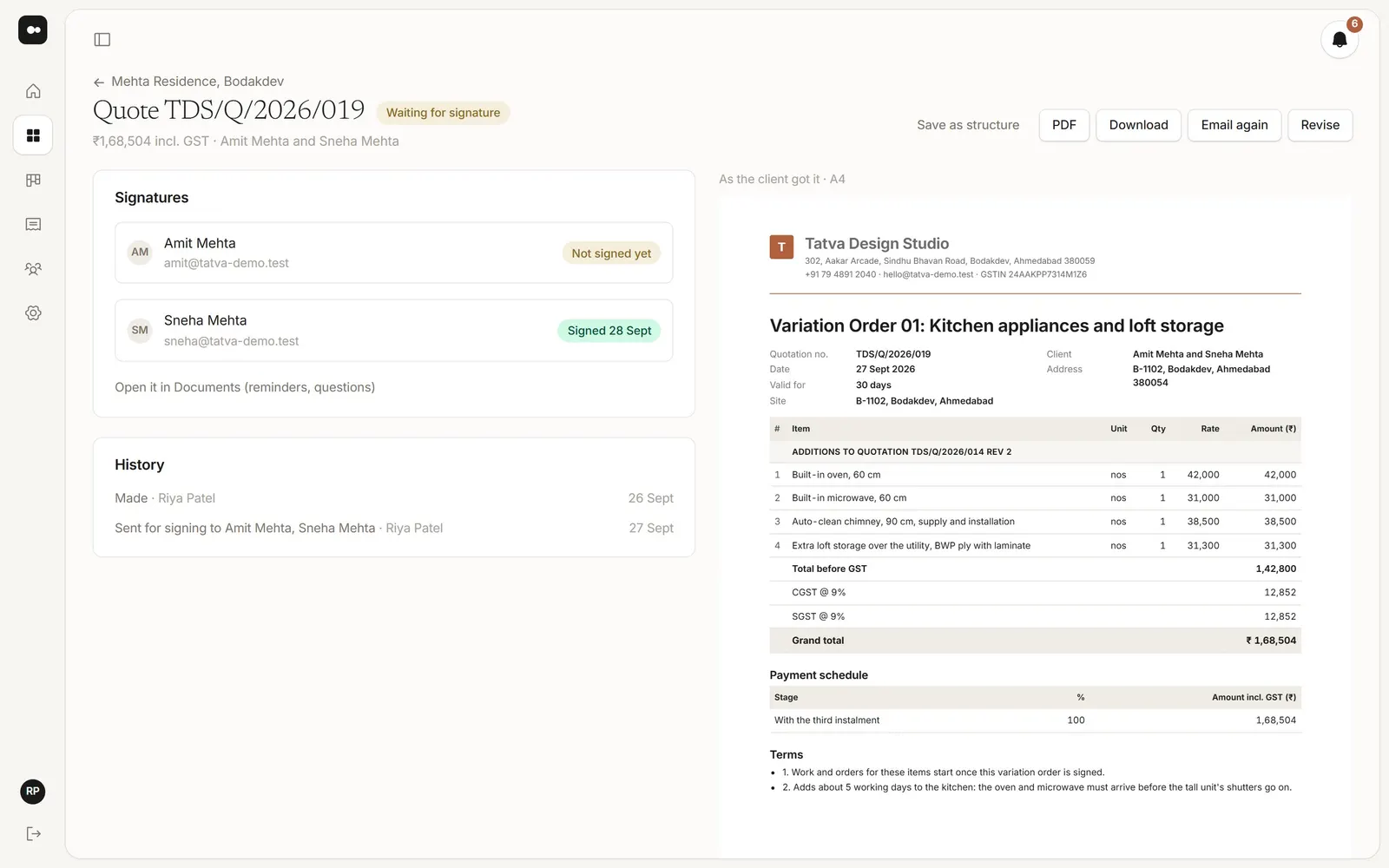
Each client signs on their phone. Every revision is kept, and each stage of the payment schedule becomes a numbered GST invoice in one click. Plott only records payments: your client pays you directly. How to make a GST quote · What else Plott covers
Common questions
Is GST charged on an interior design quotation?
The quotation shows the GST your client will pay, and the tax is charged on the invoices that follow. Interior works are usually charged at 18%: CGST and SGST when the client is in your state, IGST when they are in another. Check the rate for any goods you supply on their own with your CA.
What is the difference between a quotation and a BOQ?
A BOQ (bill of quantities) lists each item with its unit, quantity and rate. A quotation is the full offer: the BOQ plus GST, payment stages, terms, validity and signatures. In interior work the BOQ usually sits inside the quotation.
How long should an interior design quotation be valid?
Long enough for the client to decide, and short enough that material prices don't move under you. Pick a period such as 15 or 30 days, write it on the quote, and re-check prices if the client signs after it.
Should design fees be shown separately from execution?
It helps. A separate section for design fees shows what the client pays for design and what for execution, and lets you invoice the design stages on their own.
Do I need a GST number to send a quotation?
No. If you are not registered for GST, send the quotation without GST. Once you are registered, show your GSTIN on every quote and charge GST on your invoices.
Should I send a quotation as a Word file or a PDF?
A PDF, or a link the client opens. A Word file can be edited after you send it, and an old one reused for a new client can carry the wrong name or rates.